

Product · Sales
From Transcripts to Orchestration: What's Next for Sales Systems
Published 11/3/2026
For years, AI in sales was used for practically one thing: recording. Speech-to-text models converted calls and meetings into text, and that text captured what the customer had actually said. Reps used it to follow up faster and to end each meeting or call with a summary of what had happened. The AI listened. The rep did the rest.
When the first LLMs arrived, transcripts became summaries. Generative AI tools could help write follow-up emails tailored to a specific call or a broader context. They could also reply to messages or emails and prepare sales proposals. The rep moved from writing to reviewing and editing.
The next step was agents: systems that can act without waiting to be asked. An agent takes a task and completes it. Even so, agents generally have specific tasks. Teams run multiple agents, or skills, that each perform defined tasks within a particular context.
After agents came agentic workflows, where events and rules trigger agents without a person starting them. When a deal changes stage, a prospect opens a proposal, or a meeting ends without a next step, the right agent runs. Most sales automation works this way today. It works well for clearly defined situations, where you also have access to events that act as triggers for the actions the agent will take.
So what is the next step?
Can agent workflows capture a whole playbook and act autonomously alongside sales teams?
In general, a sales playbook is not only a list of rules like "if X happens, do Y". A playbook describes stages, strategies, actions, and requirements for an opportunity to move forward in the pipeline. However, these stages rarely unfold consistently or predictably. A playbook must also be robust enough to explain how to act in specific situations: a champion who goes silent, a procurement team that joins late, a competitor that appears on the last call. And it defines a strategy: which personas to engage, which proof matters to each buyer, and when to push or wait.
Encoding all of that as triggers creates a brittle system. Every new edge case needs a new rule, and the rules conflict with each other.
Playbooks are written for people. People read context, weigh alternatives, and decide on the solution they judge best to keep an opportunity moving. Agents need the same understanding, and it has to live where the system can use it.
The era of orchestration
The next step for sales teams is to move to agent orchestration. Instead of disconnected agents, a central intelligence system coordinates them. It knows which tools exist, which agent owns each task, and what the sales team expects from each account and each stage.
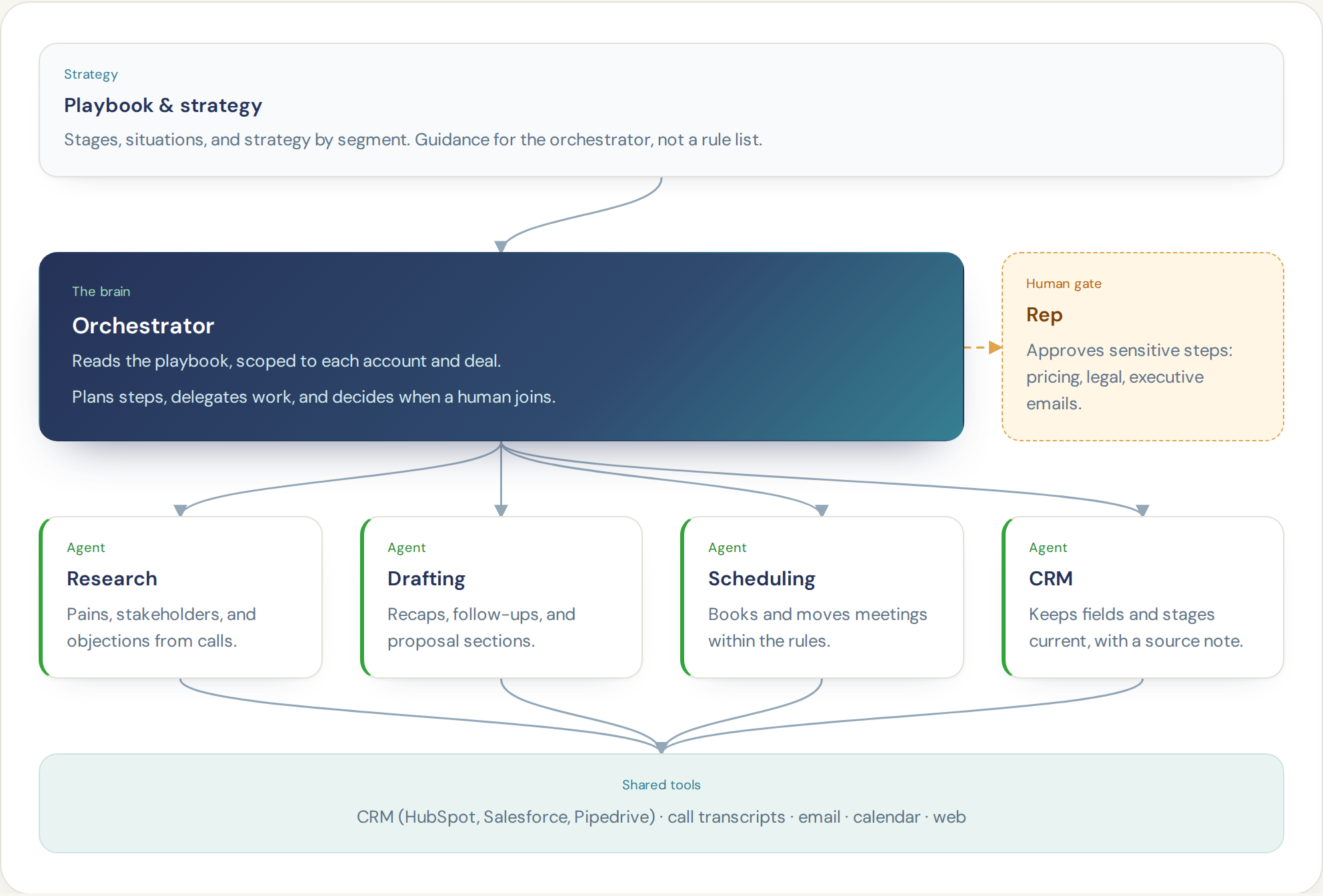 Figure 1: Who does what. The playbook sets strategy, the orchestrator plans, agents act through tools, and a rep joins when a decision is sensitive.
The orchestrator is not the playbook turned into code. It works like a senior teammate who has read the playbook. It knows how the playbook applies to this account, this contact, and this opportunity today. It decides what happens next, who or what does it, and whether a person approves it first.
In practice, that means four things:
- Delegation: The orchestrator routes work to the right specialized agent (research, drafting, scheduling, or CRM updates) and checks the results.
- Planning: It sequences work across days and weeks. It follows the stage of each object in the CRM and the buyer's pace instead of firing everything at once.
- Human judgment where it matters: It brings in a rep for sensitive, ambiguous, or high-stakes decisions. Examples: pricing, a legal term, or a message to an executive. It steps back when the work is routine.
- Scoped context: Strategy applies at the account, contact, and opportunity level. This way, the orchestrator can launch different agents for different cases and account types.
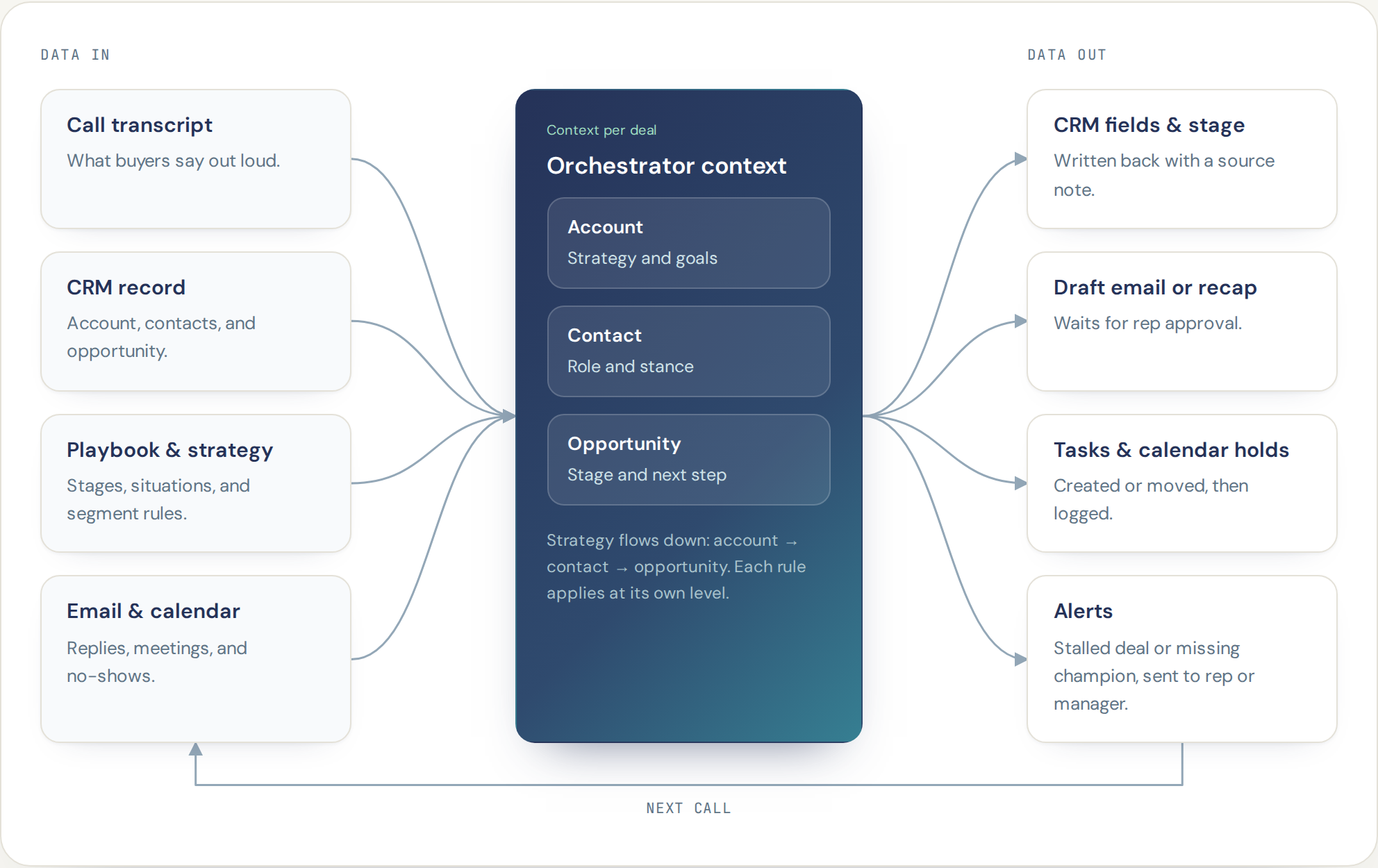 Figure 2: Data flow. Four sources feed the orchestrator's context for each deal. It writes results back and loops into the next trigger.
Guardrails are essential. Each agent needs boundaries on what it can access, what it can change, and when it must escalate. The orchestrator is only as trustworthy as the constraints around it.
What one flow looks like
Take a common case: a demo ends with no next step set. The orchestrator checks the playbook and starts a research agent and a drafting agent. It holds the draft for the rep. When the rep approves, the email agent sends it, and the CRM records the next step and a response deadline to continue with the next task or the sales follow-up.
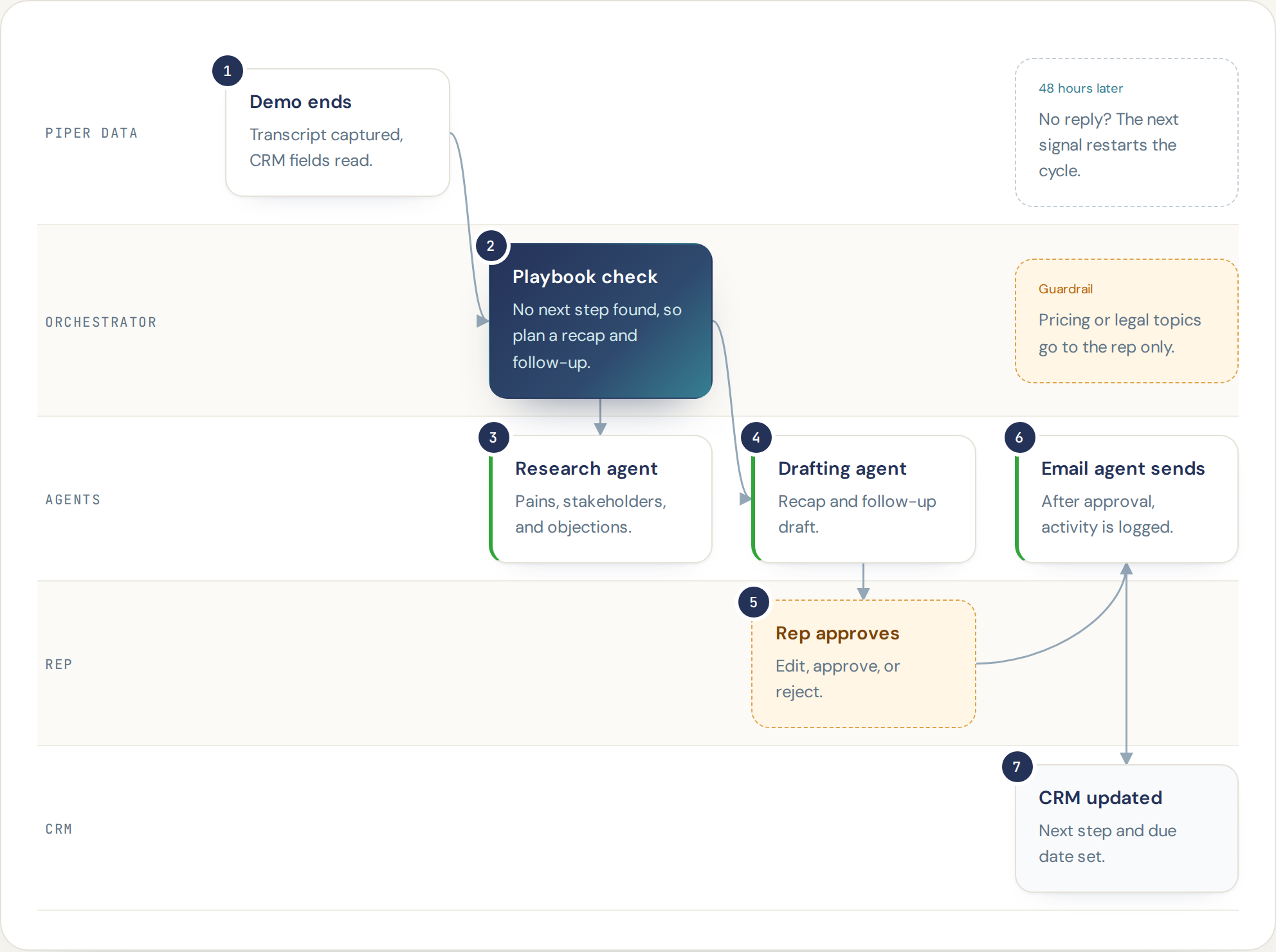 Figure 3: Step by step. A demo ends with no next step. The orchestrator coordinates research, drafting, a rep approval gate, sending, and the CRM update.
The same logic runs for every trigger. The orchestrator loads the scope, checks the risk, and either acts or routes to a rep. Each result becomes the input for the next step. But the orchestrator is free to do more than act as an agent at one particular stage. It can decide what is needed at every moment, in a dynamic context that updates with what the team and the prospect or customer contribute.
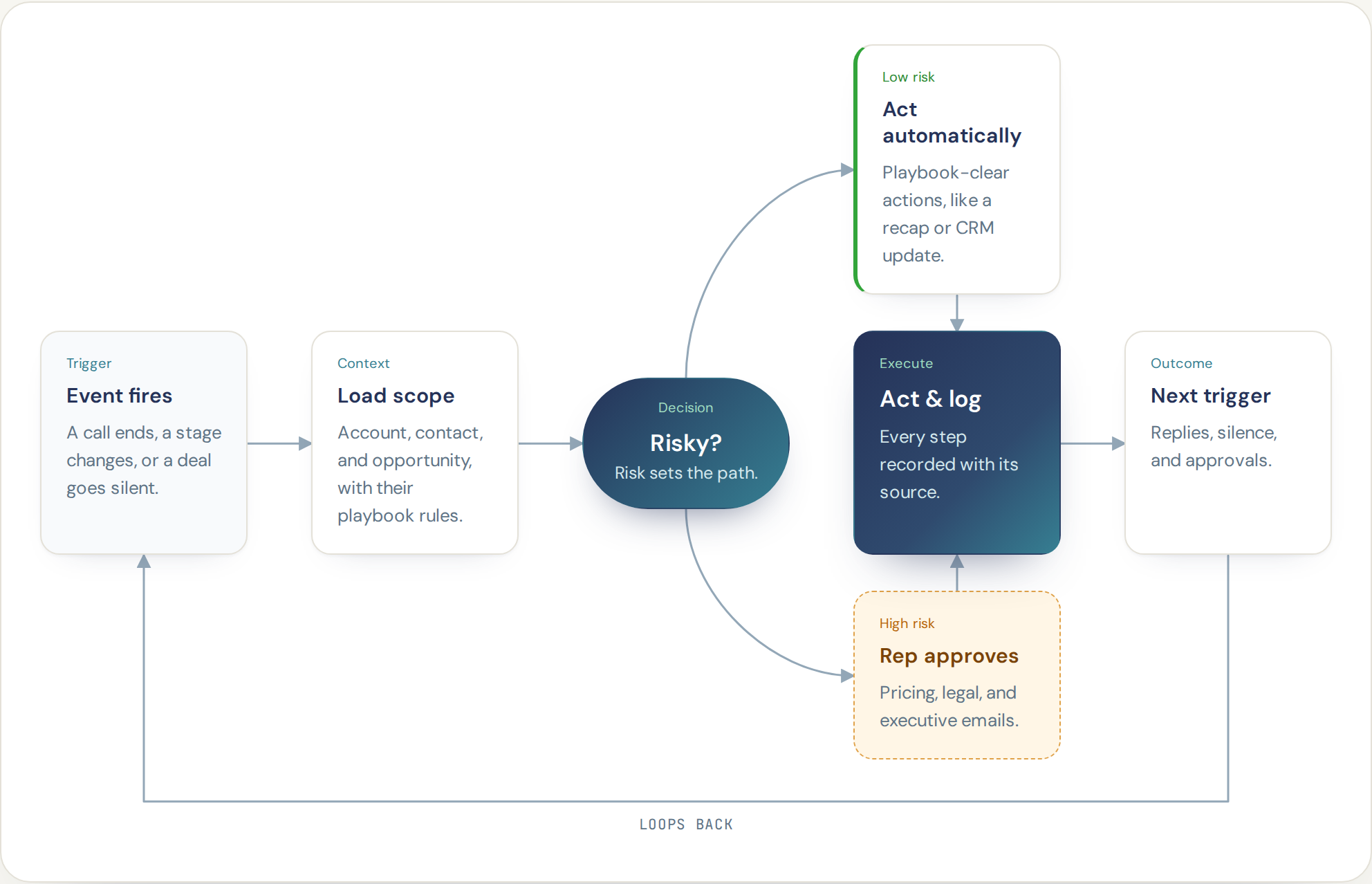 Figure 4: Decision logic. Every event loads its context and checks risk. The orchestrator acts on its own or asks a rep for approval, then logs the result.
What this means for sales teams
For reps, the shift is from operating tools to supervising outcomes, and to being the differentiating judgment in highly complex situations. Instead of remembering to send a recap, update a field, or check whether a champion replied, they review a queue of prepared decisions aligned with the sales playbook the team defined. They act on the tasks that need their judgment.
The playbook changes too. It stops being a document in a shared drive and becomes a living strategy that systems follow. Sales leaders update how the team handles a situation, and the change reaches every account where it applies. In other words, we move from a static document to a living document. It can be calibrated based on the success it has had in other accounts and active opportunities.
Where Piper is going
At Piper, we started the same way, with agentic workflows and automation of context and data extraction tasks. We are now building a system where knowledge captured in calls and the written playbook determine what happens next. The goal is not to replace sales judgment. The goal is to apply it consistently and at scale across sales teams, at the right moment and in every account, without relying on manual tasks to keep the context of each opportunity up to date.
The era of recording calls gave sales teams a memory. The era of agents gave them hands. The era of orchestration gives them a command center that knows the strategy and knows the people, to keep the engine always running at high revs.
Want to see how Piper can become your sales command center? Book a demo.